

Hey friend,
Welcome back to the Primal Question Newsletter.
If this is your first time reading, subscribe here to receive future posts. If this edition is helpful, use this link to share it with your spouse, significant other, or anyone else who might benefit!
I’m just going to come out and say it.
I don’t do Valentine’s Day.
No flowers. No chocolates. No fancy dinner reservations. No expensive gifts. My wife, Jennifer, and I usually get Chinese takeout and call it a night.
Now, before you write me off as a heartless husband, hear me out.
I’ve been married to the same woman for 30 years. Our relationship is getting stronger and stronger, not weaker. I’m not skipping Valentine’s Day because I’m trying to avoid relational effort. I just think Valentine’s Day is a total sham.
In my opinion, it’s second only to Hollywood Rom-coms for being one of the biggest traps our culture has set for couples.
Here’s why.
Valentine’s Day sells you a lie about what love actually is.
First of all, the whole holiday was created by Hallmark.
It’s a commercial enterprise designed to sell greeting cards and overpriced roses (and by the way, I think it’s working out pretty well for them). Let’s be honest. It has nothing to do with helping couples actually connect.
And yet we’ve bought into this narrative that one big day of grand gestures is somehow the measure of love.
But love is not about the big moments.
Love is about the boring, consistent, everyday stuff that nobody would ever bother to put on Instagram or the silver screen. Love is about consistency. It’s about repetition. It’s about building something slowly over decades, not one dramatic evening per year.
It’s sacrificial. It’s doing what you don’t want to do because you love the other person more than you value comfort in the moment. It’s doing the hard repair work, even after a minor rupture. It’s choosing your person over and over again in the mundane moments when nobody’s watching.
Valentine’s Day teaches the exact opposite.
Valentine’s Day says go big for one day each year.
It says: spend money, get dressed up, bring impressive gifts. Create a spectacle. Make it look good.
I guess my frustration has built because I see this confusion play out constantly in my coaching practice.
People come to me with failing marriages, and they think the solution is a grand gesture. A surprise trip. An expensive piece of jewelry. A dramatic declaration. They think one moment will turn the tide.
Even worse? I remember hearing about a pastor who had an affair. Do you want to know what he did to make it up to her? He bought his wife a Lamborghini. As if that was somehow going to fix things. As if the price tag on a car could repair the broken trust in his marriage.
You’ve got to be kidding me.
If it needs to be said: that’s not how you win your spouse back.
Here’s what I know after decades of working with couples.
The couples who thrive aren’t the ones with the most romantic Valentine’s Day plans.
They’re the ones who consistently meet each other’s deepest needs… in the most unsexy ways. Day after day. Week after week. Year after year. Decade after decade.
Making sure the door is locked every night and the floodlights work.
Managing the budget each week and building up a runway of emergency savings.
Remembering that small thing they mentioned and asking about it later.
Initiating face-to-face quality time when it’s easier to just watch TV.
Noticing and naming something small that they did well today.
Letting little imperfections go without comment or correction.
Reminding them why their work (paid or unpaid) matters.
Notice that each of these answers a Primal Question.
In my book, The Seven Primal Questions, I talk about how every person has a core emotional need. Your one job is to meet that need for your spouse. Maybe your spouse needs to feel secure. Maybe they need to feel loved. Maybe they need to know they’re good enough. Maybe they need to know they matter.
The question is: Are you answering that need on February 15th? And the 16th? And every ordinary Tuesday for the rest of the year?
One fancy dinner doesn’t make up for 364 days of emotional absence. One bouquet of flowers doesn’t heal months of your passive-aggressive comments. One grand gesture can’t compensate for a pattern of not really seeing your partner.
So what should you do instead?
First, learn what your spouse actually needs from you. Not what Hallmark says they need. Not what Hollywood has convinced them they’re supposed to want. What do they actually need in your relationship? Have them take the Primal Question Assessment to find this out.
Second, get boring. Find small, repeatable ways to meet that need every single day. Maybe it’s a quick text during the workday. Maybe it’s actually putting your phone down during dinner. Maybe it’s the repair conversation after you mess up. None of this is glamorous. But it’s real love.
Third, ask for feedback. What feels like love to you might not register for them. Check in regularly: ‘Am I answering your question with a yes?’ Do you feel safe? Do you feel good enough? Do you feel wanted by me?
Look, I’m not saying never celebrate or go big for your spouse.
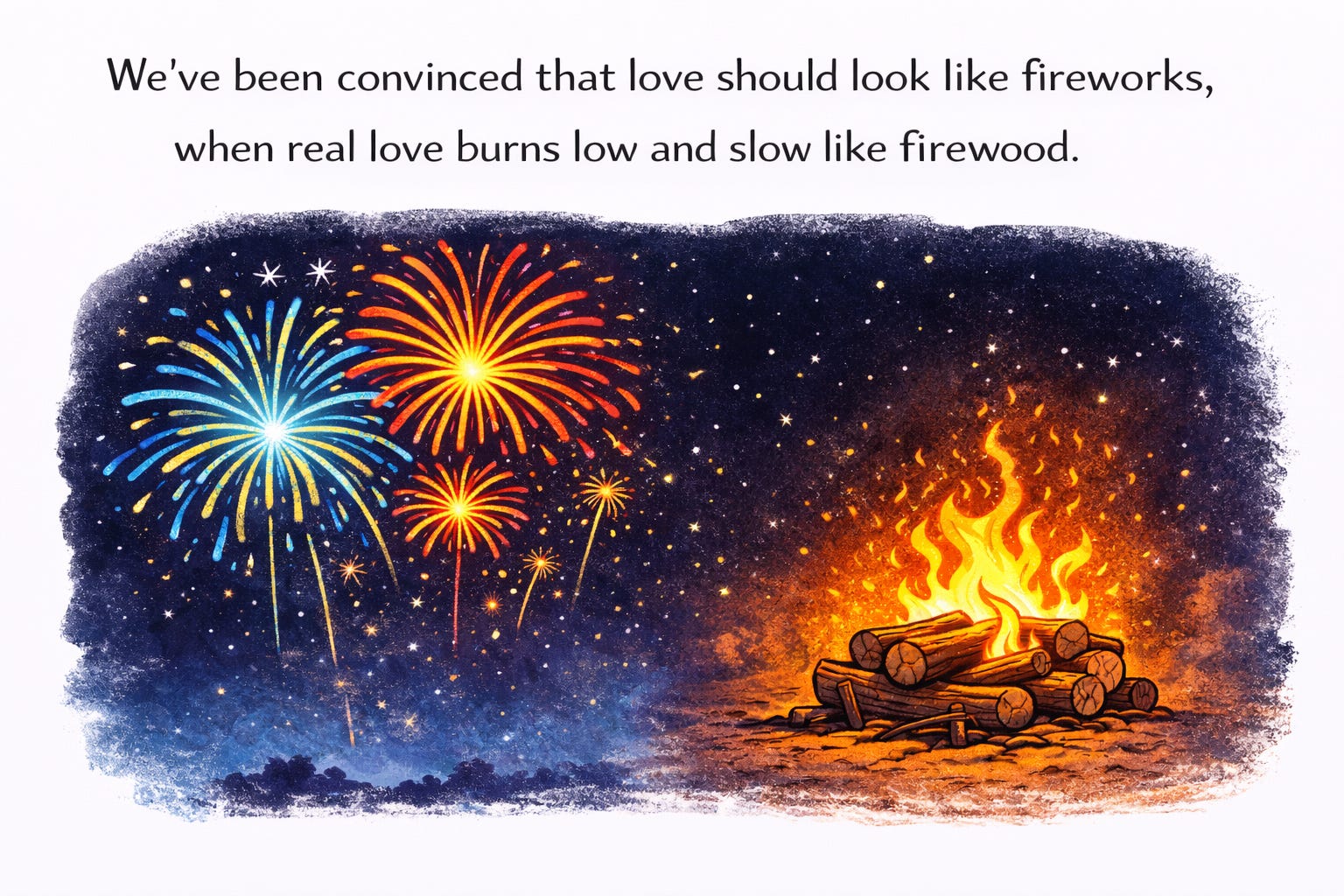
I’m not saying romance is bad. I’m saying we’ve been sold a narrative about love that sets us up for failure. A narrative that says love should look like fireworks, when real love burns low and slow like firewood.
So this Valentine’s Day, maybe skip the overpriced restaurant. Grab some takeout. Have a real conversation with your partner.
Ask them, “Which of these seven questions do you resonate with the most?”
Am I safe?
Am I secure?
Am I loved?
Am I wanted?
Am I successful?
Am I good enough?
Do I have a purpose?
Then ask, “What are 2 ways I can answer this with a YES every day for you? And what are 2 ways I can avoid answering it with a NO?”
That’s worth more than any bouquet of flowers.
To love that lasts,
Mike Foster
P.S. Quick reminder. If this was helpful, please share it with someone else. And let me know your thoughts in the comments. I love it when you all contribute to the conversation 🙌
I've felt this same way for years. Thanks for saying it Mike!
Every marriage counselor should pass this on.